

CNC Milling & Form Drilling Services
Threading thin-walled tubes is usually done poorly. The wall is too thin to hold enough threads, so the print calls out a weld nut, a rivet nut, or a threaded insert. Now the part needs a second operation, fixture, welder, and fastener that can still spin loose in the field.
Form drilling solves this by using the part’s own wall to build the thread. Fraser Steel runs Formdrill tooling in Haas machining centers, and it accounts for the majority of the work moving through that cell.
What Is Form Drilling?
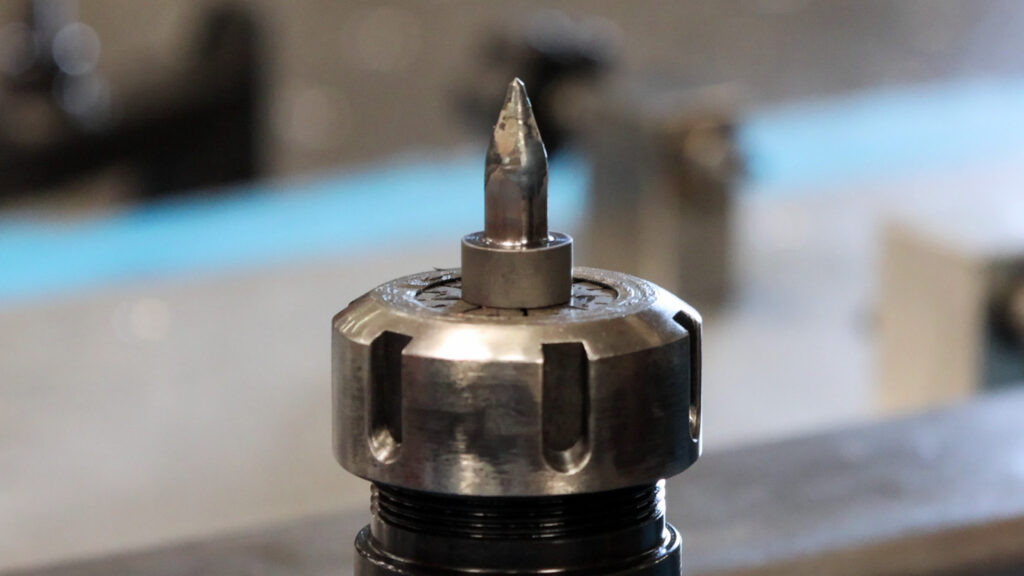
Form drilling, friction drilling, flow drilling, and thermal drilling all describe the same process. A solid carbide tool spins at high speed and presses into the metal. Friction heats the material to roughly 600–750°C, at which point it softens and moves aside rather than being cut away.
What the displaced metal forms is a bushing on the far side of the hole, roughly three times the original wall thickness. That bushing is what makes the thread possible.
The process runs in two steps:
- Form drill: The carbide tool creates the hole and forms the bushing from the parent material.
- Form tap: A forming tap shapes threads inside that bushing. Like the first step, it is chipless. The threads are formed rather than cut, producing stronger thread flanks and eliminating double pitch.
Form Drilling Compared to Conventional Fastening
| Method | How the thread is made | Trade-offs |
|---|---|---|
| Form drilling + form tapping | Parent material displaced into a bushing about 3× wall thickness, then thread-formed | No added parts, welding, or chips, thread engagement well beyond what the wall alone allows |
| Weld nut | Separate nut welded over a drilled hole | Added part cost, welding time, deburring, heat distortion, and a weld to inspect |
| Rivet nut/threaded insert | Fastener mechanically set into a drilled hole | Added part cost; inserts can spin under torque (the failure that sends parts back) |
| Drill and tap | Threads cut directly into the wall | Limited by wall thickness; often impossible when thread pitch exceeds the wall |
Our Haas Machining Centers
Fraser Steel operates three Haas machining centers configured for form drilling and milling.
Haas GR-510 Gantry Router (×2)
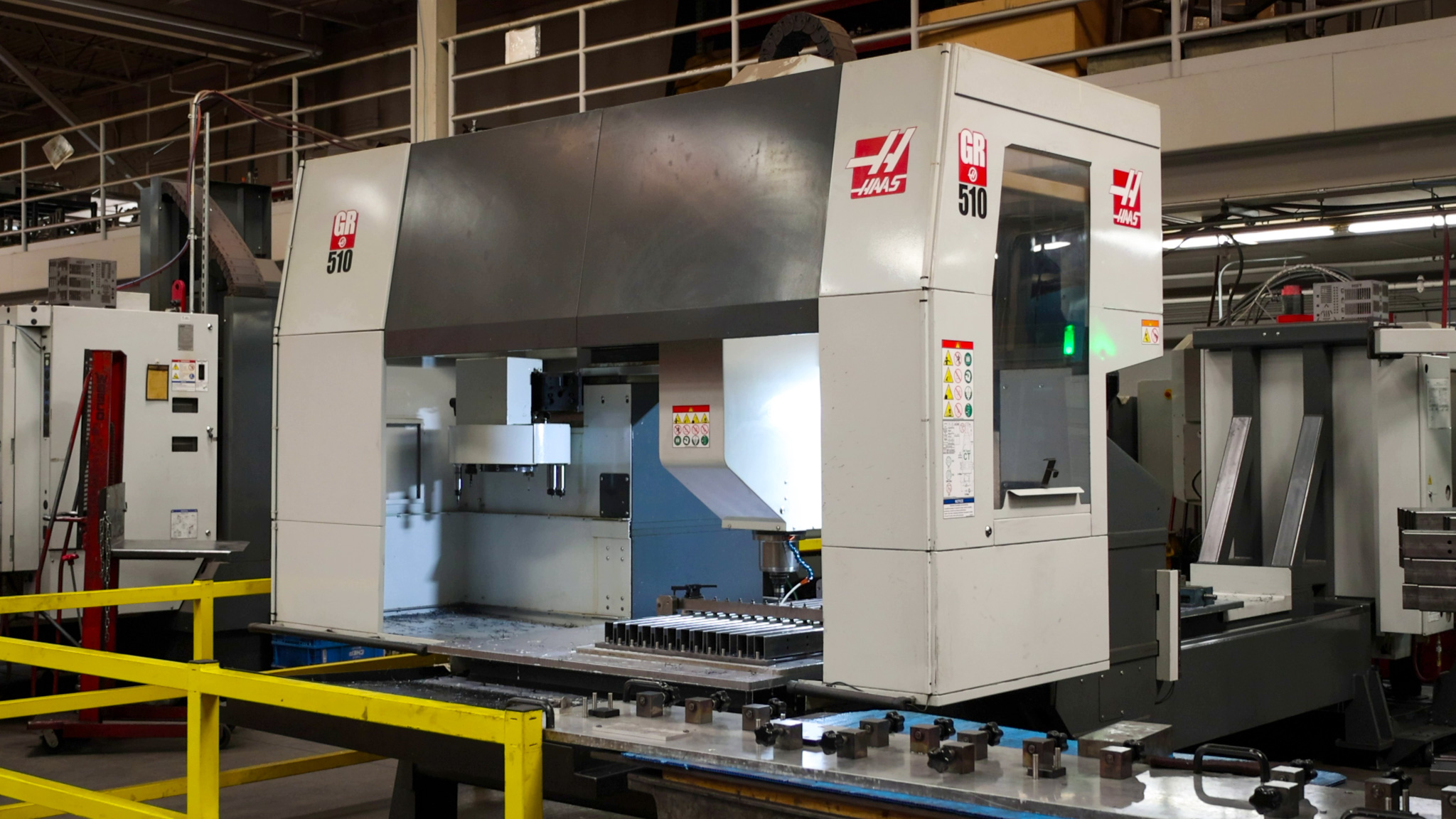
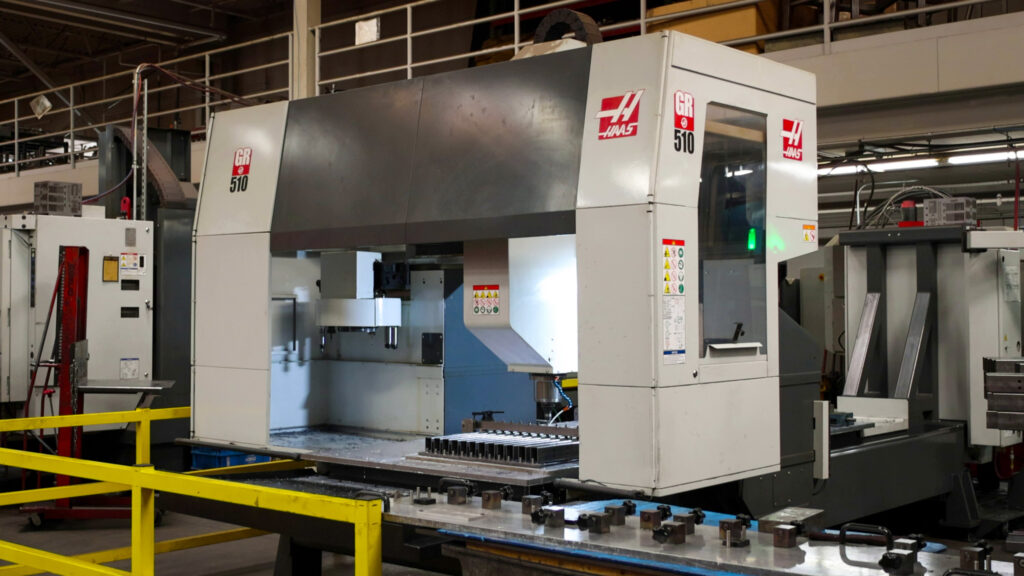
The GR-510 is a large-platform 40-taper gantry machine. Haas builds the GR Series on rigid steel construction with a 1-inch aluminum table, and positions the platform to handle large sheets or machine small parts by the thousand.
This machine allows us to form drill-and-mill assemblies that are already welded, such as full frames, long-tube weldments, and large fabricated structures that do not fit in a conventional vertical mill. Most shops offering form drilling can only take small parts in a vise.
| Specification | Value |
|---|---|
| Travels (X/Y/Z) | 121" × 61" × 11" |
| Table size | 122" × 53" |
| Max weight on table | 6,000 lbs |
| Spindle | 40 taper, 15 hp, 8,100 rpm |
| Tool changer | 10-pocket carousel |
Haas VF-4SS Super-Speed Vertical Machining Center
Where the gantries handle size, the VF-4SS handles speed. Haas Super-Speed machines pair a 12,000-rpm inline direct-drive spindle with an ultra-fast side-mount tool changer and high-speed rapids on every axis, built for high-volume production and shorter cycle times.
Tool changes measured in seconds matter on a part carrying a dozen holes and several milled features. Across a production run, that is where the hours go.
| Specification | Value |
|---|---|
| Travels (X/Y/Z) | 50" × 20" × 25" |
| Table size | 52" × 18" |
| Spindle | 40 taper, 30 hp, 12,000 rpm, inline direct-drive |
| Rapids | 1,400 in/min on all axes |
| Tool change | 1.6 sec tool-to-tool, 2.2 sec chip-to-chip |
CNC Milling on Fabricated Parts
The same machines cut features into parts that have already been laser cut, bent, and welded. Slots, pockets, faced surfaces, counterbores, mounting pads, and drilled and tapped holes all go in after the assembly is built, which means the feature locates off the finished part rather than off a single tube that may move during welding. For customers whose parts need both form drilling and milling, the process happens in one setup, on one machine, at one vendor.
Where Form Drilling Works
Form drilling suits any part where a fastener has to anchor into thin-wall material:
- Tube frames and chassis requiring threaded mounting points
- HVAC and thermal assemblies where a leak-free threaded port matters
- Solar structures with repeated bolted connections across long runs
- Exercise equipment and furniture where a visible weld nut is an appearance problem
- Agricultural and recreational vehicle assemblies exposed to vibration and repeated torque
It works across mild steel, stainless steel, aluminum, brass, and copper. Send us the print, and we will tell you whether your wall thickness and hole size are candidates.

We’re ISO 9001:2015 Certified
A threaded connection that fails is a warranty claim, and often a safety issue. Our ISO 9001:2015 certification means an independent auditor verifies that the way we form, machine, and inspect these connections is documented, repeatable, and reviewed for improvement.
Partner with Fraser Steel
Our engineers work with customers to design parts that assemble faster and cost less to build. If your current print calls out weld nuts or threaded inserts in thin-wall tube, send it over. That is often the fastest way to reduce costs on the whole assembly. Request a quote and start working with the “SWAT Team of Tubing.”
Industries We Serve
Fraser Steel’s willingness to adapt to meet the ever-changing needs of a variety of industries makes it the go-to supplier of world-class quality products and services.
Frequently Asked Questions
What is form drilling?
Form drilling uses a spinning carbide tool to generate frictional heat that softens the metal and pushes it aside rather than cutting it away. The displaced material forms a bushing roughly three times the original wall thickness, giving a thin-wall part enough depth to hold a strong thread.
Is form drilling the same as friction drilling or flow drilling?
Yes. Form drilling, friction drilling, flow drilling, and thermal drilling are different names for the same process.
Why is a form-drilled thread stronger than a tapped hole in a thin-wall tube?
Cutting a thread into a thin wall removes material from a section that has little to spare, and the wall itself limits the number of engaged threads. Form drilling adds depth rather than removing it, so the thread engages a bushing several times thicker than the original wall.
Can form drilling replace weld nuts and rivet nuts?
In most thin-wall applications, yes. It removes the need for the purchased fastener, welding or setting operation, and risk of an insert spinning under torque.
What materials can Fraser Steel form drill?
Mild steel, stainless steel, aluminum, brass, and copper. Suitability depends on wall thickness and hole diameter, so send us the print for review.
Can you machine a part that is already welded?
Yes. Our Haas GR-510 gantry machines have a 122″ × 53″ table rated for 6,000 lbs, so completed weldments and long tube assemblies can be fixtured and machined as finished assemblies.